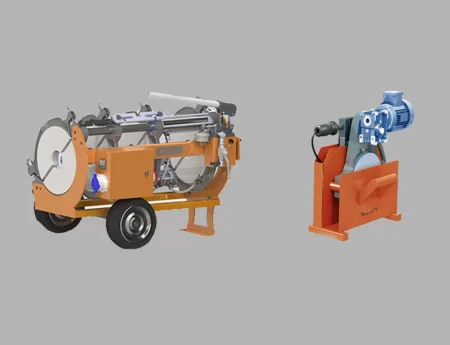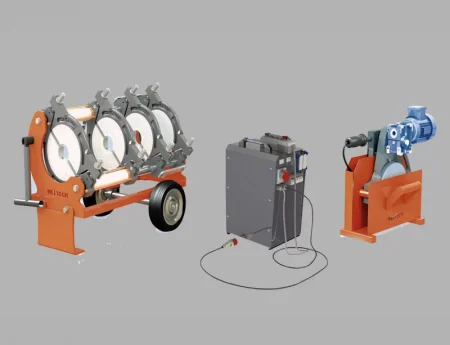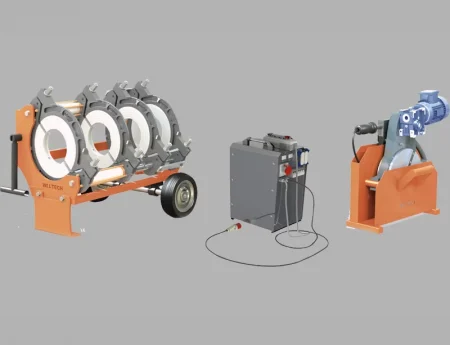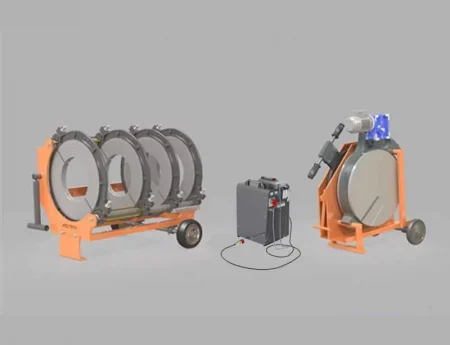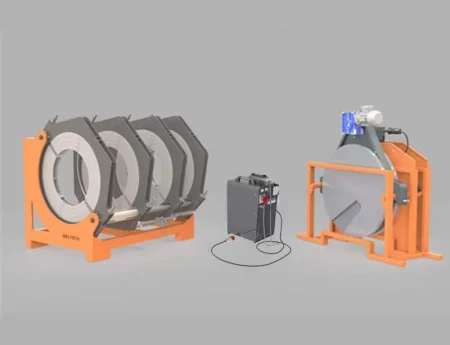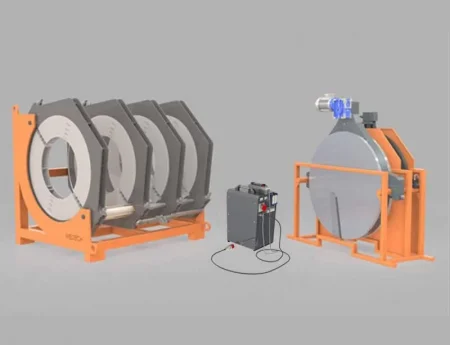
Radius Star Piping is a trusted supplier of Butt Fusion Welding Machines and CNC Butt Welding Machines across the UAE, Oman, Saudi Arabia and Bahrain. With a physical base in Al Qusais Industrial Area, Dubai, and more than a decade of proven project delivery across the GCC, we supply hydraulic butt fusion machines, manual butt fusion machines, CNC butt welding machines and plastic pipe welding stations for pipe diameters ranging from 63mm to 2000mm.
Our butt fusion welding machines are manufactured by WRAS-approved, ISO 9001:2015 certified Elbor Makine and are designed and built in accordance with ISO 12176-1, the international standard for butt fusion jointing equipment. Welding operations carried out with our machines comply with DVS 2207-1, DVS 2207-11 and ISO 21307 welding procedure standards, satisfying the documentation requirements of government and utility authority projects across the UAE, Oman and Saudi Arabia.
Whether you are a contractor on a water distribution project in Riyadh, a pipeline installer in Muscat or an EPC firm in Dubai, our team provides the right machine, on-site training and full after-sales support.
Talk to an expert about your project needs.
Butt fusion welding machines are purpose-built systems that join thermoplastic pipes by heating both pipe ends to their melting point and pressing them together under controlled hydraulic pressure. The result is a homogeneous, molecular-level bond that creates a joint stronger than the pipe wall itself.
There are no fittings, gaskets or mechanical connectors involved. The finished joint is leak-proof, corrosion-resistant and engineered to last 50 years or more under continuous operating pressure.
These machines are the primary joining method for HDPE (PE100), MDPE, PP and PVDF pipes across the following applications:
CNC butt welding machines add computer-controlled automation to the standard butt fusion process. A programmable control unit manages pipe alignment, heating temperature, fusion pressure and cooling time according to pre-set welding parameters. This eliminates operator variability and produces welds of consistent, auditable quality across every joint.
CNC butt welding machines are the specification-grade choice for large-scale infrastructure projects where weld traceability, data logging and compliance documentation are required by the project engineer or client.
Understanding the process of butt fusion welding machines helps you select the right machine and ensures your team follows the correct procedure for every joint.
Both pipe ends are inserted into the machine clamps and aligned so the centrelines are concentric. Proper alignment at this stage determines joint geometry and prevents eccentricity in the finished weld.
A rotating facing tool trims both pipe ends simultaneously, producing smooth, parallel surfaces that are perfectly perpendicular to the pipe axis. Facing removes contamination, surface oxidation and any burrs left from cutting.
A PTFE-coated heating plate, pre-set to the correct temperature for the pipe material (typically 200°C to 230°C for PE100), is inserted between the two pipe ends. Both ends are brought into contact with the plate under a specified drag pressure, then held under heat soak pressure for a calculated period based on pipe wall thickness.
The heating plate is removed and the two molten pipe ends are brought together immediately under a controlled fusion pressure. The contact creates a bead on both sides of the joint, confirming proper material displacement.
The joint is held under pressure throughout the cooling cycle. Releasing pressure before full solidification compromises joint integrity. Cooling time is calculated by the machine based on wall thickness and ambient temperature.
The weld bead is inspected visually for uniform size, symmetry and the absence of voids, notches or contamination. For critical applications, ultrasonic or radiographic testing may follow.
| Machine type | Pipe diameter range | Pressure control | Best for | Weld traceability |
|---|---|---|---|---|
| Manual butt fusion | 63mm to 315mm | Operator-controlled | On-site repairs, small-bore installations | None |
| Hydraulic butt fusion | 63mm to 2000mm | Hydraulic unit, automatic | Municipal pipelines, industrial projects | Optional data logger |
| CNC butt welding | 110mm to 2000mm | Fully automated via PLC | Large-scale infrastructure, gas pipelines, compliance-driven projects | Built-in data logging |
| Plastic pipe welding station | 630mm to 2500mm | Hydraulic with remote control | Large-bore pipeline construction, tracked and wheeled variants | Data logger available |
Talk to an expert to learn more.
| Specification | Range |
|---|---|
| Pipe material compatibility | HDPE (PE80 and PE100), MDPE, PP, PVDF |
| Minimum pipe diameter | 40mm |
| Maximum pipe diameter | 2500mm (hydraulic range) |
| Maximum pipe diameter (CNC range) | 2000mm |
| Pipeline operating pressure | Up to 32 Bar |
| Hydraulic working pressure (W160 to W630) | 150 Bar |
| Hydraulic working pressure (W1000 to W2500) | 200 Bar |
| Heating plate coating | PTFE coated, digital thermostat controlled |
| Power supply (standard) | 380V three-phase |
| Power supply (smaller models, on request) | 220V single-phase |
| Operating ambient temperature | Minus 10°C to plus 40°C |
| Compliance standards | ISO 12176-1, DVS 2207-1, DVS 2207-11, ISO 21307 |
Want to know about the product specifications of a machine? Talk to an expert.
We supply a full series of machines for butt fusion welding that cover every project scale, pipe diameter, and site condition found across the UAE, Oman, and Saudi Arabia.
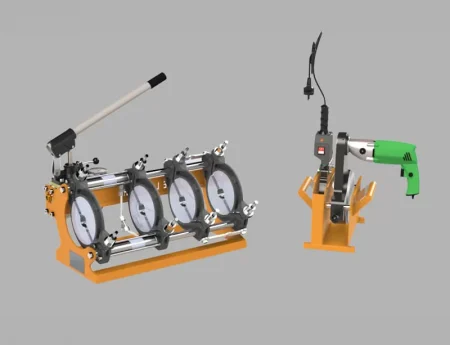
Our hydraulic butt fusion machines are built for heavy-duty applications where consistent pressure control is non-negotiable. Each unit comes with a hydraulic power station, dual-channel digital timer and a removable PTFE-coated heating plate for accurate temperature management. Models in our hydraulic range include the W160, W250, W315, W400, W500, W630, W800, W1000, W1200, W1600, W2000 and W2500 series, covering pipe diameters from 63mm up to 2500mm.
The MHW and MHTW series provide the same hydraulic clamping precision in a configuration suited for sites with limited power supply, confined access or smaller pipe schedules. Models include MHW160, MHW250 and MHW315, handling pipes from 63mm to 315mm. Subcontractors and repair teams widely use these machines for distribution network maintenance across the GCC.
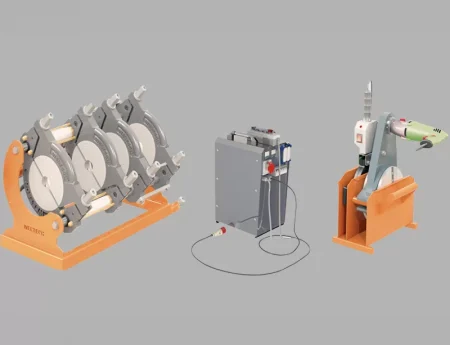
Our CNC butt welding machines combine automated pressure and temperature management with full data logging capability. The PLC-controlled welding cycle stores weld parameters, operator ID, date, time, heating duration and cooling time for every joint, producing a complete traceability record. This documentation is required on gas pipeline projects, DEWA-approved water schemes and Saudi Aramco subcontractor work. Contact our team for the current CNC model range and pipe diameter specifications.
For large-diameter pipeline construction projects, our pipe welding station range handles pipes from 630mm to 2500mm. The W1600 and W2000 station models include hydraulic centralisers, powered rollers, remote-control operation and optional caterpillar track mobility for use in trench conditions. These are the preferred choice for bulk water transmission, trunk sewer construction and desalination pipeline projects across the KSA and the UAE.
| Pipe diameter you are working with | Recommended machine | Machine type | Suitable for |
|---|---|---|---|
| 40mm to 160mm | W160 or MHW160 | Manual or hydraulic | Distribution connections, repair work |
| 63mm to 250mm | W250 or MHW250 | Manual or hydraulic | Small bore mains, irrigation headers |
| 90mm to 315mm | W315 or MHW315 | Manual or hydraulic | Distribution mains, small trunk mains |
| 160mm to 400mm | W400 or CNC W400 | Hydraulic or CNC | Municipal water mains, industrial headers |
| 200mm to 630mm | W500 to W630 | Hydraulic or CNC | Trunk mains, sewer rising mains |
| 450mm to 1000mm | W800 to W1000 | Hydraulic or CNC | Bulk water transmission, large sewer mains |
| 710mm to 1600mm | W1200 to W1600 | Pipe welding station | Major transmission pipelines, desalination |
| 1400mm to 2500mm | W2000 to W2500 | Pipe welding station | Large-diameter bulk water, industrial trunk lines |
Butt fusion welding is the standard joining method for HDPE water mains across the GCC. In the UAE, DEWA and ADWEA-approved pipeline projects specify PE100 pipe joined by ISO 12176-compliant butt fusion machines. In Saudi Arabia, NWC (National Water Company) and SWCC infrastructure projects in Riyadh, Jeddah and Makkah actively use CNC butt welding machines to meet traceability requirements.
In gravity sewer and rising main applications, where chemical resistance and root ingress protection are priorities, we specify HDPE piping joined by butt fusion. Our machines are used by contractors working on Abu Dhabi sewerage authority projects, SWMC Oman networks and Saudi Arabia municipal drainage schemes.
Gas distribution pipelines in the UAE (ADNOC Distribution, SEWA) and Saudi Arabia (Saudi Aramco, Saudi Gas) require CNC butt welding machines with full data logging to satisfy weld traceability and pressure testing records. Our CNC range is compliant with the DVS 2207-1 welding procedure standard referenced in GCC gas utility specifications.
HDPE and PP pipe joined by butt fusion is used extensively in chemical dosing lines, cooling water systems, effluent treatment and process pipework at industrial facilities across Jebel Ali, KIZAD, Sohar Industrial Port and the Saudi industrial cities (MODON). Our hydraulic machines handle PP and PVDF in addition to HDPE, covering the material range required for industrial process pipe systems.
Large-scale irrigation networks across the Saudi agricultural regions, Omani wilayats and UAE protected farms use HDPE pipes joined by butt fusion in diameters from 110mm to 630mm. Manual and hydraulic machines from our range are deployed on these projects by irrigation contractors throughout the GCC.
Desalination plants at Fujairah, Ras Al Khaimah, Yanbu, Jubail and Salalah use HDPE piping for seawater intake, brine discharge and product water distribution. Butt fusion welding machines for large-diameter pipe (630mm to 2000mm) are a standard supply requirement for EPC contractors on these projects.
Operating from Dubai with stock held locally in Al Qusais Industrial Area, we deliver machines to Dubai, Abu Dhabi, Sharjah, Muscat, Riyadh, Jeddah and Dammam without extended lead times. Contractors on live projects cannot wait weeks for equipment to arrive.
Every machine we supply meets ISO 12176-1 and DVS 2207-1 welding standards. Our company holds ISO 9001:2015, ISO 14001:2015, ISO 45001:2018 and WRAS approval, providing the quality assurance documentation that government-approved projects require.
Our factory-certified technicians provide on-site operator training, machine commissioning and calibration for every new supply. We also offer periodic re-calibration services to maintain weld quality and compliance over the lifetime of the equipment.
For short-duration projects or contractors managing capital equipment budgets, we offer butt fusion welding machine rental across the UAE, Oman and Saudi Arabia. Rental machines are maintained to the same calibration standard as sold equipment.
We stock genuine spare parts including heating plates, facing tool blades, hydraulic seals and control units for the full range we supply. Machine downtime on a pipeline project is expensive; our Dubai-based service team responds quickly to support requests.
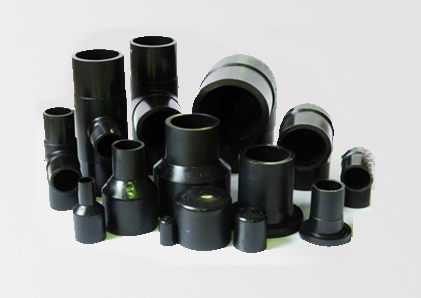
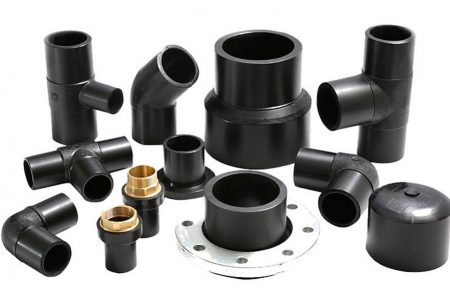
Alongside welding machines, we supply HDPE pipes, butt-fusion fittings, electrofusion fittings, fabricated fittings, manifolds and puddle flanges. Sourcing pipes, fittings and welding equipment from a single supplier eliminates compatibility risk and simplifies project procurement.
Radius Star Piping supplies butt fusion welding machines and CNC butt welding machines to contractors, utilities and project owners across Dubai, Abu Dhabi, Sharjah, Muscat, Riyadh, Jeddah, Dammam and the wider GCC region.
Call us at +971 4 269 3863 or email info@radiusstarpiping.com to discuss your pipe schedule, machine requirements or rental enquiry. Our technical team will recommend the right equipment for your specific project and ensure it arrives ready to work.
Butt Fusion Welding Machines use a manual or hydraulic system to join plastic pipes by melting and fusing their ends together, whereas CNC Butt Welding Machines provide automated control, offering higher precision and consistency for large-scale and high-volume projects. CNC machines are ideal for situations requiring repeatability and accuracy in the welding process.
Butt Fusion Welding Machines are commonly used in industries like construction, water and gas distribution, chemical processing, and any field requiring durable, high-pressure, and temperature-resistant plastic pipe connections. These machines ensure long-lasting, leak-proof joints for critical applications.
While Manual Butt Fusion Machines are ideal for smaller projects or tight spaces, they may not be suitable for large-scale applications due to their limited power and automation. For large projects, it is recommended to use Hydraulic Butt Fusion Machines or CNC Butt Welding Machines, which are designed for more demanding and high-volume tasks.
The choice of machine depends on factors such as project size, pipe diameter, material, and the level of automation required. For small to medium projects, Manual Butt Fusion Machines are suitable, while Hydraulic Butt Fusion Machines and CNC Butt Welding Machines are better for large-scale and complex tasks. Our team can guide you in selecting the perfect machine based on your specific needs.
Yes, we offer comprehensive training and support for all of our Butt Fusion Welding Machines and CNC Butt Welding Machines. Our team ensures that your operators are well-trained to use the machines effectively and safely. We also provide after-sales support to ensure the continued performance and maintenance of your equipment.
Butt Fusion Welding Machines are available for different pipe sizes, depending on the model. Our range supports HDPE pipes from 63 mm up to 2500 mm, making them suitable for everything from small utility projects to large water and industrial pipelines.
Butt fusion welding joins two pipe ends by heating and pressing them together to create one continuous joint. Electrofusion welding uses special fittings with built-in heating coils to connect pipes. Butt fusion is commonly used for straight pipeline installations, while electrofusion is often preferred for repairs, branch connections, or areas with limited working space.
When installed correctly, a butt fusion welded joint can last 50 years or more, which is the same design life as the HDPE pipe itself. The joint becomes part of the pipeline, creating a strong and reliable connection with very little maintenance.
Yes. Butt Fusion Welding Machines are designed to operate in the high temperatures commonly experienced across the UAE, Oman, and Saudi Arabia. The machine controls the heating process to help produce reliable welds, even in demanding outdoor conditions.
No. While they are mainly used for HDPE pipes, many Butt Fusion Welding Machines can also weld other thermoplastic materials such as PP (Polypropylene) and PVDF. The welding settings are adjusted based on the type of material being joined.